


Roulette is a casino game where you bet on which numbered pocket a small ball will land in when a wheel stops spinning. The game gets its name from the French word for “little wheel.” You can place bets on single numbers, groups of numbers, or characteristics like red or black colors and odd or even numbers.
The game has been around for centuries and remains popular in casinos worldwide. When you play roulette, you’re trying to predict where the ball will stop on a spinning wheel that contains numbered pockets from 0 to 36. The dealer spins the wheel in one direction and rolls the ball in the opposite direction.
Learning roulette is straightforward once you understand the basic betting options and how the wheel works. This guide will walk you through the game’s structure, explain the different types of bets you can make, and help you understand the odds. You’ll also learn about different roulette versions and approaches that players use.
Understanding Roulette
Roulette combines a spinning wheel, a betting table, and simple rules that let you bet on where a small ball will land. The game comes in different versions with slight variations in wheel layout and house edge.
Roulette Rules
The basic rules of roulette are simple. You place bets on a numbered table before the dealer spins the wheel and drops a small ball in the opposite direction. When the ball stops in a numbered pocket, the dealer marks the winning number and pays out all winning bets.
You can place your bets until the dealer calls “no more bets.” The dealer then clears losing chips from the table and pays winners based on the type of bet placed. A single number bet pays 35 to 1, while a red or black bet pays 1 to 1.
After all payouts are complete, a new round begins. You must wait for the current round to finish before collecting your winnings or placing new bets for the next spin.
Roulette Wheel and Table Layout
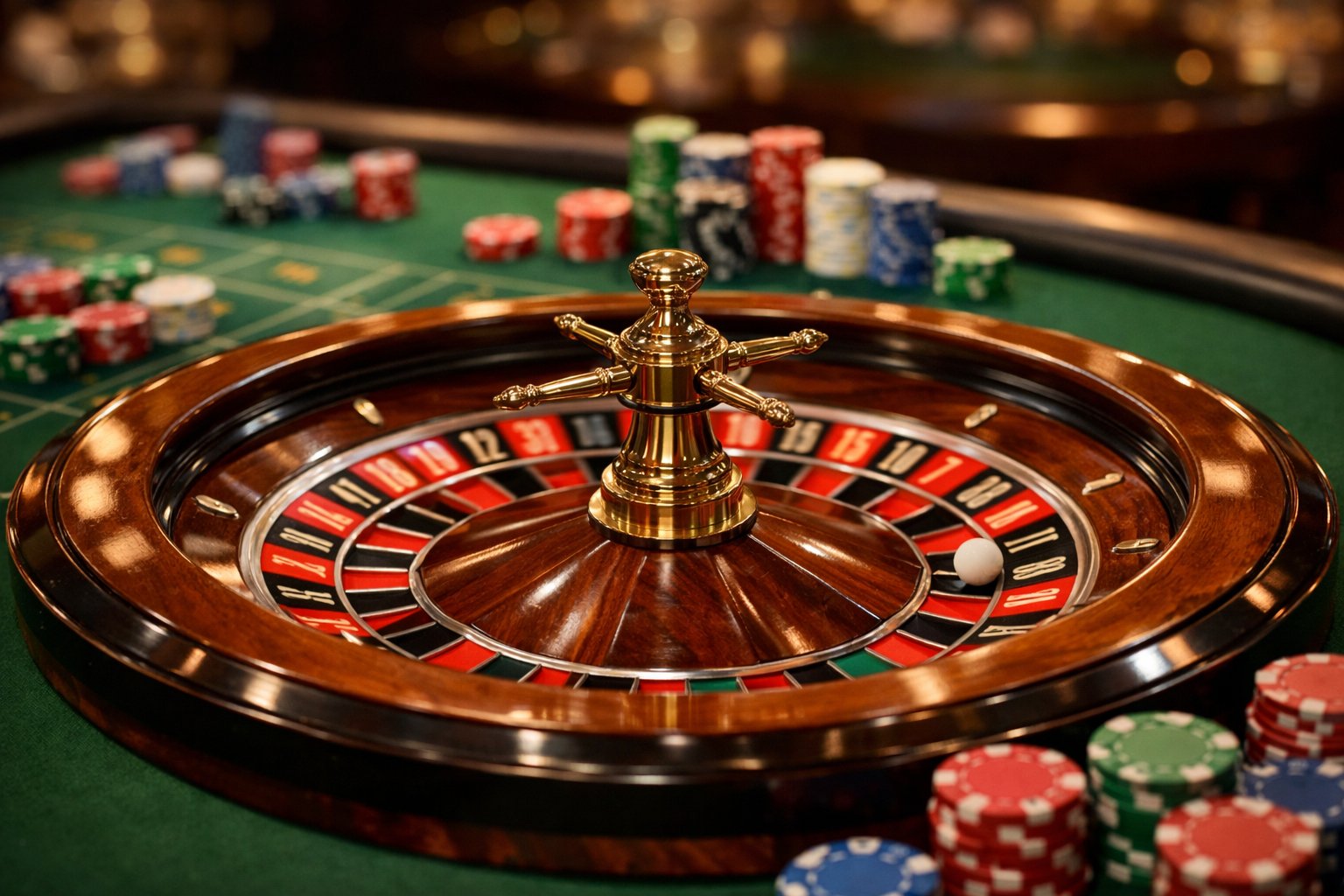
The roulette wheel is a circular spinning device with numbered pockets around its edge. Each pocket is colored either red or black, except for the green zero pockets. The numbers 1 through 36 alternate between red and black colors.
The betting table shows all available betting options. It displays individual numbers arranged in a grid, along with outside betting areas for red/black, odd/even, and number ranges. The table layout matches the wheel’s numbering system so you can easily place your bets.
You can place chips directly on numbers or on the lines between them to cover multiple numbers with one bet.
Types of Roulette Games
European roulette has 37 pockets total: numbers 1-36 plus a single zero. This version gives the house an edge of 2.7%.
American roulette includes 38 pockets by adding a double zero (00) alongside the single zero. The extra pocket increases the house edge to 5.26%, making it less favorable for you.
French roulette uses the same wheel as European roulette but offers special rules like “La Partage” and “En Prison.” These rules return half your bet or let you carry it to the next spin when the ball lands on zero, reducing the house edge to 1.35% on even-money bets.
Roulette Bets and Odds
Roulette offers two main categories of bets with different risk levels and payouts. The house edge varies depending on which version of roulette you play, affecting your long-term winning chances.
Inside and Outside Bets
Inside bets are placed on specific numbers or small groups of numbers on the main betting grid. A straight bet covers a single number and pays 35 to 1. A split bet covers two adjacent numbers and pays 17 to 1. Street bets cover three numbers in a row and pay 11 to 1.
Corner bets cover four numbers that meet at a corner and pay 8 to 1. Six-line bets cover two adjacent rows of three numbers and pay 5 to 1. These bets offer larger payouts but have lower chances of winning.
Outside bets are placed on the outer sections of the betting layout. Red/black, odd/even, and high/low (1-18 or 19-36) each pay 1 to 1 and cover 18 numbers. Dozen bets cover 12 numbers (1-12, 13-24, or 25-36) and pay 2 to 1. Column bets also cover 12 numbers running vertically on the layout and pay 2 to 1.
Payouts and Probabilities
Your winning probability depends on how many numbers your bet covers. On a European wheel with 37 pockets, a straight bet has a 2.70% chance of winning. A dozen or column bet has a 32.43% chance. Red/black, odd/even, and high/low bets each have a 48.65% chance.
On an American wheel with 38 pockets, these probabilities decrease slightly. A straight bet drops to 2.63%, while red/black bets fall to 47.37%. The extra zero pocket reduces your winning chances across all bet types.
The payout structure remains consistent regardless of which roulette version you play. Your actual return depends on combining the fixed payout rates with the probability of winning each bet type.
House Edge in Roulette
The house edge represents the casino’s mathematical advantage over time. European roulette has a house edge of 2.70% on all bets because it contains one zero pocket. This means you can expect to lose $2.70 for every $100 wagered over the long run.
American roulette has a house edge of 5.26% due to the additional double zero pocket. This nearly doubles the casino’s advantage compared to European roulette. Some casinos offer triple-zero roulette, which increases the house edge to 7.69%.
French roulette offers the lowest house edge at 1.35% on even-money bets when the “La Partage” rule applies. This rule returns half your bet if the ball lands on zero. Your choice of roulette variant significantly impacts your expected losses over time.
Roulette Strategies and Variations
Players use different betting systems to manage their bankrolls, while roulette comes in several versions that affect the house edge and your chances of winning.
Popular Roulette Strategies
Several betting systems help you organize your wagers at the roulette table. The Martingale strategy requires you to double your bet after each loss, returning you to your original bet size when you win. This system works best with even-money bets like red/black or odd/even.
The D’Alembert system offers a gentler approach. You increase your bet by one unit after a loss and decrease it by one unit after a win. The Fibonacci system follows a mathematical sequence where each bet equals the sum of your two previous bets.
The James Bond strategy spreads your money across multiple bets in a specific pattern. You place larger amounts on high numbers and smaller amounts on low numbers and zero. This covers more of the table but requires a bigger starting bankroll.
No strategy changes the house edge or guarantees wins. These systems only help you structure your betting and manage your money during play.
Notable Game Variants
European Roulette features 37 pockets with numbers 1-36 and a single zero. The house edge sits at 2.7%, making it more favorable for players than other versions.
American Roulette adds a double zero pocket for 38 total spaces. This increases the house edge to 5.26%, cutting your winning chances compared to European tables.
French Roulette uses the same wheel as European roulette but includes special rules. The “La Partage” rule returns half your even-money bet when the ball lands on zero. The “En Prison” rule lets you leave your bet for another spin instead of losing it.
Online roulette offers these variants plus speed versions and live dealer games. The rules stay the same, but you can play at your own pace from home.

Leave a Reply